Full disclosure: this wasn’t going to be this week’s topic, but something happened yesterday. I am lucky enough to work with teachers to try and improve their practice, and work with small groups of students. Yesterday, a cool, enthusiastic teacher asked me a very important question whilst we were discussing ways to avoid burnout and stress.
“How do we fix the profession?”
What a great question! What a depressing question! What a difficult question to answer!1
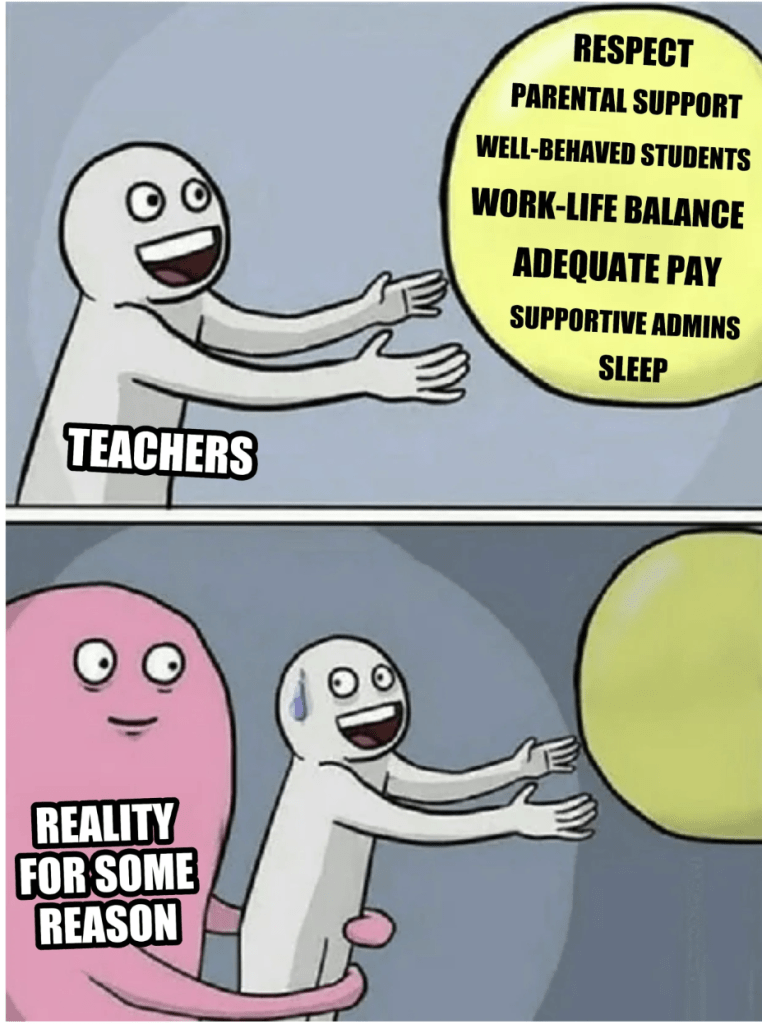
Found by searching memes about teaching. Depressingly, I didn’t have to search for long to find this one.
I’ve been thinking about it ever since, and my first, off the cuff response remains unchanged: money.
The only way to fix teaching and education, especially in the UK, is to throw money at it. We’ve had a couple of decades of funding problems for education. In England (note not the U.K.), the average per pupil is currently £7,920, up from £7,120 in 20162. In between those dates, the amount went up and down, but has increased every year since about 2018. These are official government statistics. This also varies by region, which I really don’t understand. Are students in Devon not worth as much as those in London? Are they lower class citizens? The median3 salary is around £51,0004, with leadership roles on considerably more. It takes roughly 6.5 students to cover one teachers salary. That’s before we get to Teaching Assistants, admin staff, premises staff etc, etc.
Given how much expense schools have (eg exams, electricity bills) it’s just not enough money. Tony Blair once said he wanted every student to have as good an education as himself. His school currently costs £18000 per term. Again, to help non-mathematicians, that’s £54000 per year, or nearly 7 times what the state equivalent gets.
7 times more.
Think what your local state school could do with that. Smaller class sizes, more teaching assistants5, better facilities. It is commonly considered that private education is better than state, but it’s a numbers game through and through. More money would help improve state. Finland is usually held up as an example here as they don’t have private schools6 and their education system has blossomed.
So, to go back to the question how do we fix education in the U.K., here are some thoughts7:
- Make your nearest school the one you go to. No exceptions.
- Increase school funding massively. This would help point 1 be more palatable.
- Pay teachers more, and launch the biggest recruitment drive ever seen in the country. Teaching is a great job, but it’s also difficult and demanding.
- Pay teaching assistants a LOT more. Train them, but pay them a wage that’s more in line with what they actually do.
- Reduce the curriculum. Students study around 10 GCSEs. That’s probably 4 too many for most students. If you reduced the number of subjects, you could increase the demand and rigour of each one.
- Root and branch reform of each subject as many are no longer fit for purpose. For example, maths should be functional, with a huge emphasis on financial literacy. You could call it ‘Numeracy’ or similar and then have a GCSE option called ‘Mathematics’ which would cover the more abstract areas such as algebra. Maybe this would stop the ‘Another day when I didn’t use quadratic equations’ memes. It would stop the ‘when am I going to use this?’ question faced by maths teachers on a daily basis, but still provide routes to A level and beyond. It should not be an ‘easy’ exam, but focus more on real world problems. I despair when I see a ‘real world problem’ that reads something like “Claire buys tickets for the cinema. She buys two adult tickets and three childrens’ tickets for £35. The next week she buys three adult tickets and a child’s ticket for £27. How much is an adult ticket8?”
- For English, rename it ‘Literacy’ and focus not only on reading for pleasure, but reading to identify bias and hyperbole. This might help blow through politicians lies and half truths. Again, have an option which means you can study pre-20th century texts and so on.
- Deepen the curriculum for each individual subject, and reduce the emphasis on certain subjects9. The worst change in education was to bring the Ebacc in, which meant the Arts was somehow diminished in schools eyes as they didn’t count towards headline figures. Anyone who doesn’t think Art, Music and Drama are important is an idiot who really shouldn’t be listened to10.
- Think about reintroducing vocational routes – teach basic car mechanics, brick laying, etc. Students should not be locked into following either Vocational or Academic. We should move away from that distinction as it smacks of elitism. ‘You’re academic, so you must be clever’11.
- Stop exam board gamesmanship. For each subject, there should be one exam board. This can be reviewed every, say, 10 years. But stability in assessments would lead to an improvement in resources and ensure a level playing field for all schools.
- Move to collaborative lesson planning model. By now, all the core subjects should have massive banks of resources. There is no reason for people to be spending hours preparing a lesson from scratch. Teacher time should be spent adapting the plan for the current group of students in front of them.
- Lesson observations by any member of staff should always have a feedback element to it. You should NEVER be observed without feedback. Many SLTs now swoop into lessons armed with an iPad or laptop, tick a few boxes and swoop out again. You never here the results of this until you are summoned because you did something that was not quite right. No teacher wants to do a bad job, so if you see something you don’t like have the balls to say something about it, not just put it on some anonymous form that becomes someone else’s problem.
- Reduce the timetable of every single teacher by a minimum of two classes. The amount of time this would create means lessons would be better prepared, resources better differentiated etc, etc. Teacher burnout would reduce, and maybe good people would be encouraged to stay in the classroom longer, and retention numbers would improve. The DFE’s own figures have 11% quit within a year, 26% with three, 33% within five and 42% with ten. It is one of the worst rates in the developed world. It is improving, but it’s still atrocious. Obviously, reducing teaching load means we need more teachers, and it is difficult to recruit as the job is perceived as stressful12.
- Consider changing the school year. The autumn term is far too long so why not break it up. Half two-week half terms and reduce the length of the summer holiday. Everyone thinks we get far too long holidays, despite the fact we don’t actually get paid beyond 40 weeks, but the spread of the holidays leads to burnout. If you are still going strong at this point in December then hat tip to you. Usually at this point in the year I’ve had two colds or worse13, and this year I haven’t been ill at all. I put this down to not working stupid hours since September. Give a longer break and illness rates might go down.
- Consider changing the way we deal with persistent absence. This has blown up since COVID, and we should spend time with families, helping them to get their child to school. Instead, we send punitive letters and then threaten court action. Way to get people on side, schools!
Hmm, this has all been a bit serious. Sorry about that. What do you think? Am I wrong with any of these suggestions (and there’s a strong possibility of that to be fair)? What would you suggest?
Until next time.
FOOTNOTES
- That’s enough exclamation marks for one blog post. ↩︎
- Figures adjusted for inflation, so they are both in 2025 terms. Figures are dated at 24-25. ↩︎
- For the non-mathematicians, the median is the middle value, so it ignores extremes at either end of the spectrum. ↩︎
- I’m very surprised by this figure to be honest. ↩︎
- The absolute unsung heroes of education. Their salaries are shocking compared with what they actually do. ↩︎
- Except they do, but they are not for profit. England has about 50% of its private schools listed as not-for-profit charities. ↩︎
- Mine. My thoughts. These are my opinions today, and they may change tomorrow. I’m fickle like that. ↩︎
- Whatever the online booking system tells me it is. Why am I working this out? I’ve got a film to watch. ↩︎
- Obviously basic numeracy and literacy are vitally important, but I would argue neither the current GCSE Maths nor English actually do anything to achieve that. ↩︎
- Michael Fucking Gove. ↩︎
- Absolute bollocks. Some of the people I went to University with remain the stupidest people I ever met, with less common sense than a potato. ↩︎
- And it is. I nearly had a nervous breakdown a couple of years ago, and only avoided it due to the support of my wife. Love you xx ↩︎
- To quote my good friend Vince, I am a bit nesh, but then again he’s currently on holiday in Sri Lanka, so he can do one. ↩︎
 David Watkins
I think education needs a massive re-think based on European models (play until the age of 6/7) rather than trying to copy Korean/Chinese (work hard from young age and fill as much time as you can with school work) models.
I also think none of the big political parties will ever have the balls to do this because they would upset the status quo far too much for the liking of the press.
And yes, you are nesh.
Your good friend Vince (now in Thailand 😉)
LikeLiked by 1 person
Haha, I was waiting for you to read that bit. Was expecting a bit more than confirmation I am indeed ‘nesh’. Hope the rest of the trip goes well buddy!
LikeLike
Really like this article and, while I had an idea about ball park figures, the disparity between fee paying schools (which I was lucky enough to attend with a scholarship) and state is staggering.
One other thing I take issue with as a teacher is the obsession with statistics and I think this is at least partly parents’ fault. They want everything to be quantifiable. Everything measurable at every stage.
All of us teachers know that every student’s learning curve is somewhat different, in every subject. the idea that we have to say pupil X’s progress in subject y on day z is *precisely* ‘n,’ is ridiculous. And this leads to exams and even entire curricula being geared more towards correct vs incorrect, hence eliminating critical thinking and nuance. I think this is a huge problem with knock on effects beyond education alone.
LikeLike
Targets, and judging teachers as to whether students hit them is monumentally stupid. There has to be a better way.
LikeLiked by 1 person