A word has been bandied about in education over the last few years, and I think it’s one that has been much misunderstood – by everyone from support staff, students, parents, teachers and most of all, of course, SLT.
Consistency.
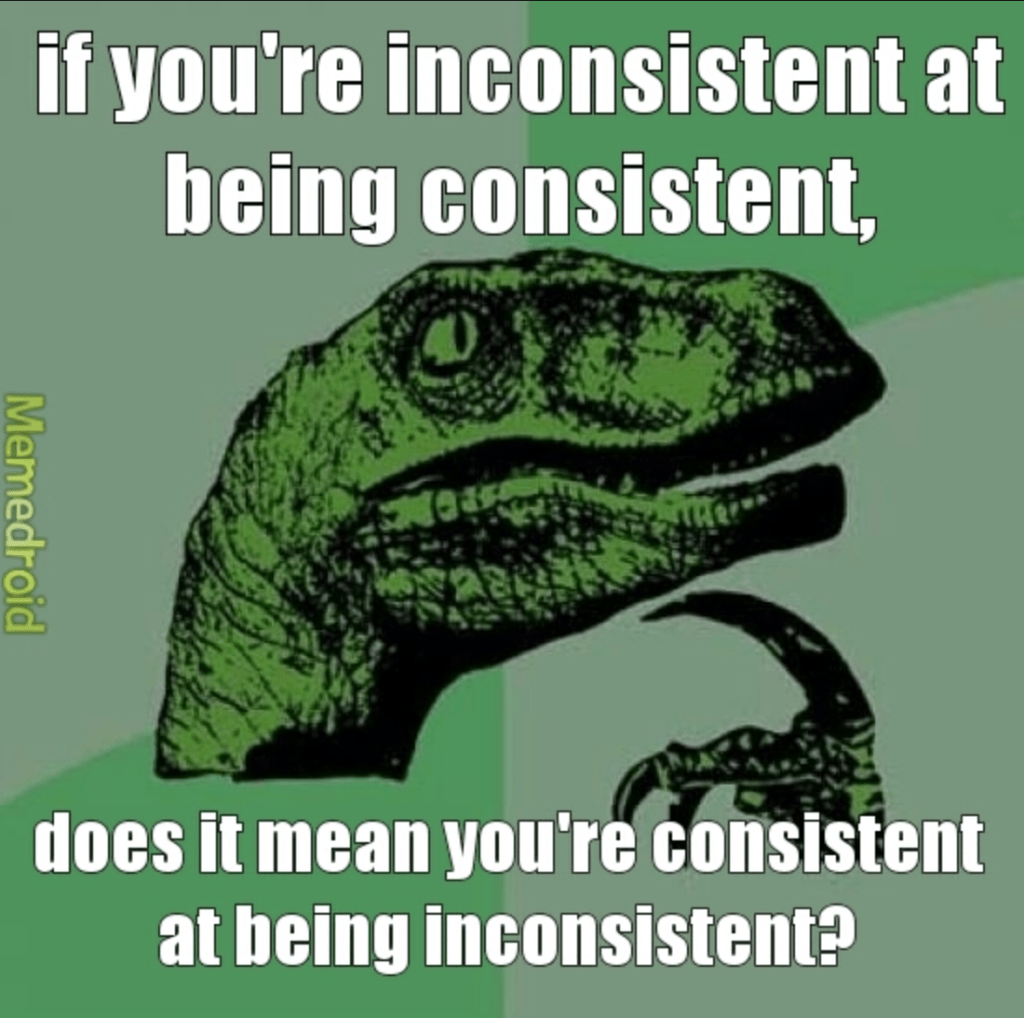
Nicked from Memedroid. Possibly my new favourite website.
But what does that actually mean in a classroom? Mine? Yours? Everyone else’s?
For me, I think it’s easier to distil what this doesn’t mean. It doesn’t mean reading from a script to ensure your lesson and words are the same as everyone else. This saps teacher agency and flair and makes everyone a robot. I’ve been in schools where every PowerPoint has to look the same – same font, same background, same colours used for each part of the lesson. I get it – it lets students know what is expected of them at each point of the lesson, but I’m really not convinced it works or is essential. Common language or approach is great and hugely desirable, but backgrounds? Really? I once spent a long time (as did my team) changing the banners on our PowerPoints so it matched what SLT demanded. It took me far too long to realise they weren’t actually checking I’d done it. It made zero difference to lessons, or to what students learned, but took an extraordinary amount of time. Absolutely pointless and more than a little frustrating. Think if we’d used the time to actually agree common methods for teaching complex ideas, or to drink more tea? How much happier would we all have been?
You want students to be inspired, enthusiastic or at the very least, to learn enough to pass an exam. If every lesson and every teacher sounds the same, how is that going to happen? They will be bored. In my experience, students who care about the subject are rare, but those who want to do well because of the teacher are common. How will this happen if we all sound the same, like robots? Zero personality allowed in lessons.
A frequent phrase doing the rounds right now is ‘keep teacher talk lean’. It means to make sure you keep your explanations succinct and to the point – no digressions, no flair around it. Now, we’ve all experienced that teacher who speaks for twenty minutes (or more) about football results, or what they did at the weekend and obviously that’s not good. However, what about those who have a passion for the subject? What about those who can talk about the historical significance of pi, or what Archimedes1 did beside run around naked? Where is the scope for that sort of teacher?
Consistency works well when it comes to behaviour management, but it is notoriously difficult to get all staff to apply the behaviour policy effectively. Teaching is about complex human interactions, so of course this will be nigh on impossible. What one person will decide is an appropriate level of noise during a task will be deafening to someone else2. What one person thinks is ‘banter’3 another will find offensive. What one person thinks is an acceptable level of work, another will find unbelievably lazy. It is really tempting to say ‘Just what the hell have you been doing?’ but the answer is usually the very accurate and honest ‘nothing’.
And to be clear – this is about teachers, not students. I was in a lesson on expanding brackets, and at the end of the lesson, the teacher said they’d all got it. I had to point out a couple of things. How did they know? At no point was there any whiteboard work, or even answers read out to check they had actually done the questions right. Also, at least half of the class did less than five questions. Now, expanding brackets is a ‘by rote’4 skill, so five questions should take less than five minutes, so spending half an hour to only do five is excruciating. Needless to say, this particular teacher5 didn’t agree and argued with my assessment the pace was too slow. He really didn’t like that I pointed out that if they’d all got it, why didn’t he move them on?
Back to consistency in behaviour management. We all want students to complete our work and love our subjects. Good behaviour management is key to that, and one of the things I try to drill into ECTs6. Good behaviour management means that students will at least learn something whether they want to or not. Right now, most schools seem to have a variation on ‘3, 2, 1, and Focus’7 This is great at getting students to shut their mouths and actually listen to the teacher, provided it is followed through on. One school has ‘3, 2, 1, Thank you.’ I asked one teacher why they were thanking the students who weren’t actually quiet at the end. Seemed a bit ridiculous to me. I haven’t even mentioned how the behaviour policy must, absolutely, no exceptions, be adhered to. Apart from SLT of course.
A quick scan of parent forums shows that this approach is not popular, with many saying it is turning students into ‘robots’. I don’t agree with that at all, as I think learning to shut up when someone is talking to a group is a bit of a key life skill, much like not talking through a film. At the very least it means they’re not being rude. Parents don’t see it like that though. ‘My kid has ADHD’. Okay, great, but he still needs to listen and not disrupt the learning of others. How about you approach the school and work together on a strategy that would keep him in lessons? But nope, all teachers are bastards8 and it’s not your kid, who does no wrong at home9.
I really believe students prefer their teachers to be human and show some kind of emotion, or even excitement about their subject, or more importantly care for them. This can manifest in many ways, from funny chats at breaktime, through to wanting to spend time in your room at break or lunch, even when it’s not pissing10 down.
The Six Nations starts this week, or bizarrely has already started due to a stupid Thursday night game11, and obviously, as a Welshman, this now fills me with dread. It never does with students though, who are always massively over-confident about their teams chances. I have always taught in England, and one year, when England won, I arrived at school on the Monday after the game to find my room absolutely covered in England flags – it was like a visit from the Reform nobheads, but before flying a flag was a sign of just how racist you could be. I didn’t say anything, and I think that wound the students up more. The following year, Wales won, and again I didn’t say anything to the group of lads, but I was extra vigilant about making sure they copied the worked examples down. I had included the score in every single example. Haha. How’s that for petty? The students all gave me a grudging ‘well played’ when I pointed it out.
Also, how exactly does any ‘script’ or must use PowerPoint allow for that?
Let’s not remove personality from teaching.
Until next time.
FOOTNOTES
- I have done both of these things, neither of which are on the curriculum. ↩︎
- I don’t mean allowing a riot, but just chatting. Although I have seen someone allow a level of noise more suited for the Principality Stadium when Wales score a try. ↩︎
- This blog is not long enough for me to describe the depths of my hatred of that word. ↩︎
- As in, follow the algorithm and you’ll get 99% of the questions correct. ↩︎
- He used to brag about getting an ‘outstanding’ grading during his PGCE, which had been thirty years before I observed him. ↩︎
- Early Career Teacher. Used to be called NQT. Newly Qualified Teacher. Bit pointless changing it really. ↩︎
- My last school used FOCUS, others use ‘eyes on me’ or ‘STAR behaviours’. No, I don’t know what it means either. ↩︎
- Dammit, I told my wife I wouldn’t swear this week. Shit, ruined it. ↩︎
- This is, of course, a lie. ↩︎
- Dammit. ↩︎
- Yep, forgot it was on. ↩︎
 David Watkins
The most important skill for a teacher is the ability to build relationships and connections with their students. You can’t do this by being relentlessly “consistent” because not all people are the same.
And also, it’s very important to make time for tea!
LikeLike